Dice Probabilities Every Gamer Should Know
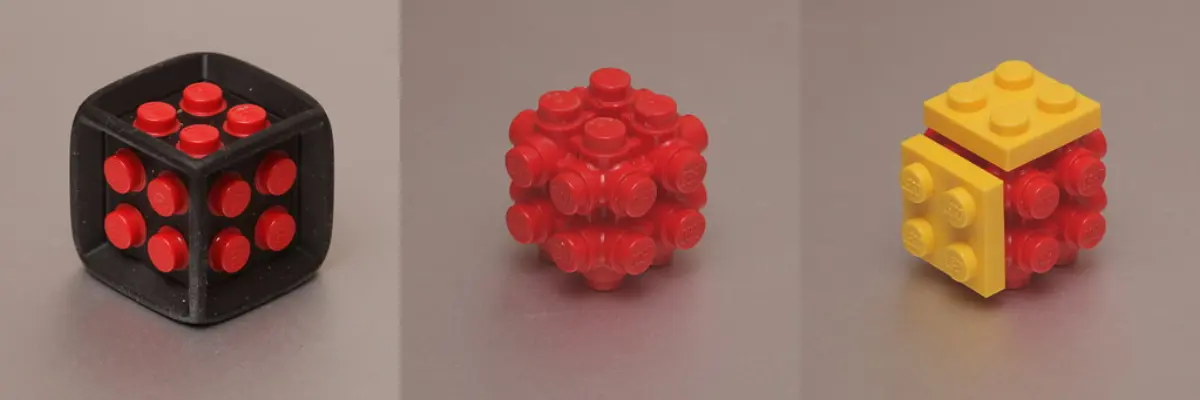
Dice feel simple, but the maths behind them shapes every tabletop and board game you play. Knowing a handful of probabilities helps you make better decisions, design fairer house rules, and stop blaming the dice for outcomes that were always likely.
One die is flat, two dice make a curve
A single fair six-sided die is uniform: each face from 1 to 6 has exactly a 1-in-6 chance, about 16.7%. The moment you add a second die, that flatness disappears. There is only one way to roll a total of 2 (1+1) and one way to roll 12 (6+6), but six different ways to roll a 7 (1+6, 2+5, 3+4 and their reverses). So 7 is six times more likely than 2 — roughly 16.7% versus 2.8%.
Add more dice and this effect strengthens into a bell-shaped curve: totals near the middle become common and the extremes become rare. This is why games that roll several dice and sum them feel more consistent than games driven by a single die — the average is reliable even though any one roll is not.
Advantage, disadvantage and 'take the highest'
Many modern games let you roll two dice and keep the better one. On a d20, rolling twice and taking the higher result (advantage) raises your average from 10.5 to about 13.8 and makes low rolls far rarer — it is worth roughly a +5 bonus in the middle of the range, where it matters most. Taking the lower result (disadvantage) is the mirror image. Understanding this helps you value abilities that grant advantage far more accurately than a flat bonus.
Modifiers shift the whole curve
A flat modifier does not change the shape of the distribution — it slides it. Adding +3 to a d20 roll moves every outcome up by three, so your chance of beating a target improves by the same amount whether the target is easy or hard. That is different from advantage, which reshapes the curve. When you tune a house rule, decide whether you want to shift the average (a modifier) or squeeze out bad luck (extra dice or advantage); they feel very different at the table.
The 2d6 table, line by line
Two six-sided dice have thirty-six equally likely outcomes, and writing them out makes the curve obvious. A total of 2 happens one way, 3 two ways, 4 three, 5 four, 6 five, 7 six — and then it mirrors back down: 8 five ways, 9 four, 10 three, 11 two, 12 one. Seven therefore lands on 6 of 36 rolls, about 16.7 per cent, while double ones and double sixes sit at 1 in 36, or 2.8 per cent each.
That asymmetry drives whole games. In Monopoly the squares six to eight steps ahead are the ones you are most likely to land on, which is why the orange properties just past jail are the most profitable on the board. In Catan, a number token showing 6 or 8 is worth roughly five times as much production as one showing 2 or 12.
Adding a third die pushes the distribution towards a bell shape and narrows it in relative terms. With 3d6 the mean is 10.5 and roughly two thirds of rolls land between 8 and 13. That is exactly why classic tabletop attribute rolls use 3d6: extreme scores stay rare without being impossible.
Exploding dice, rerolls and the d100
Several systems let a maximum roll explode: roll a 6 on a d6 and you add another d6, which may explode again. The expected value of an exploding d6 is 4.2 rather than 3.5, and the distribution grows a long thin tail — spectacular results become possible while the typical roll barely moves.
A reroll rule behaves differently. Rerolling a 1 once on a d6 lifts the average from 3.5 to about 3.92 and removes the worst outcome without touching the ceiling. And the familiar d100 built from two ten-sided dice is uniform rather than curved, because one die names the tens digit and the other the units — they are not being added, so no bell appears.
Reading a target number correctly
On a d20 every face is 5 per cent, so a target number translates directly: needing 11 or higher is 50 per cent, 15 or higher is 30 per cent, 18 or higher is 15 per cent. A +2 bonus is therefore worth ten percentage points anywhere in the middle of the range, a much bigger swing than most players assume.
The same bonus is worth much less at the extremes. If you already succeed on a 2, a +2 adds nothing beyond the natural 1, and if you need a 20 it only takes you down to 18. That is why flat bonuses feel strongest against moderately difficult targets and almost worthless against very easy or nearly impossible ones.
The takeaway
One die is uniform; summing dice creates a bell curve where middle totals dominate. Advantage reshapes the odds while flat modifiers just shift them. Roll d4 to d100 in the dice roller to see the distributions yourself.
Roll d4 to d100, add a modifier, and see every result.
More guides

True Random vs Pseudo-Random Numbers
Most 'random' numbers on a computer come from a formula. How pseudo-random generators differ from true randomness, and when it matters.
How to Run a Fair Raffle or Giveaway
A giveaway is only worth entering if the draw is fair. How to collect entries, pick winners without bias, and prove the result.
How Strong Is Your Password? Entropy Explained
Password strength is not about weird symbols — it is entropy, measured in bits. What that means, how to estimate it, why length wins.